The discovery of TW, is like a wonderful present.
I realize how thinkable and hack it is
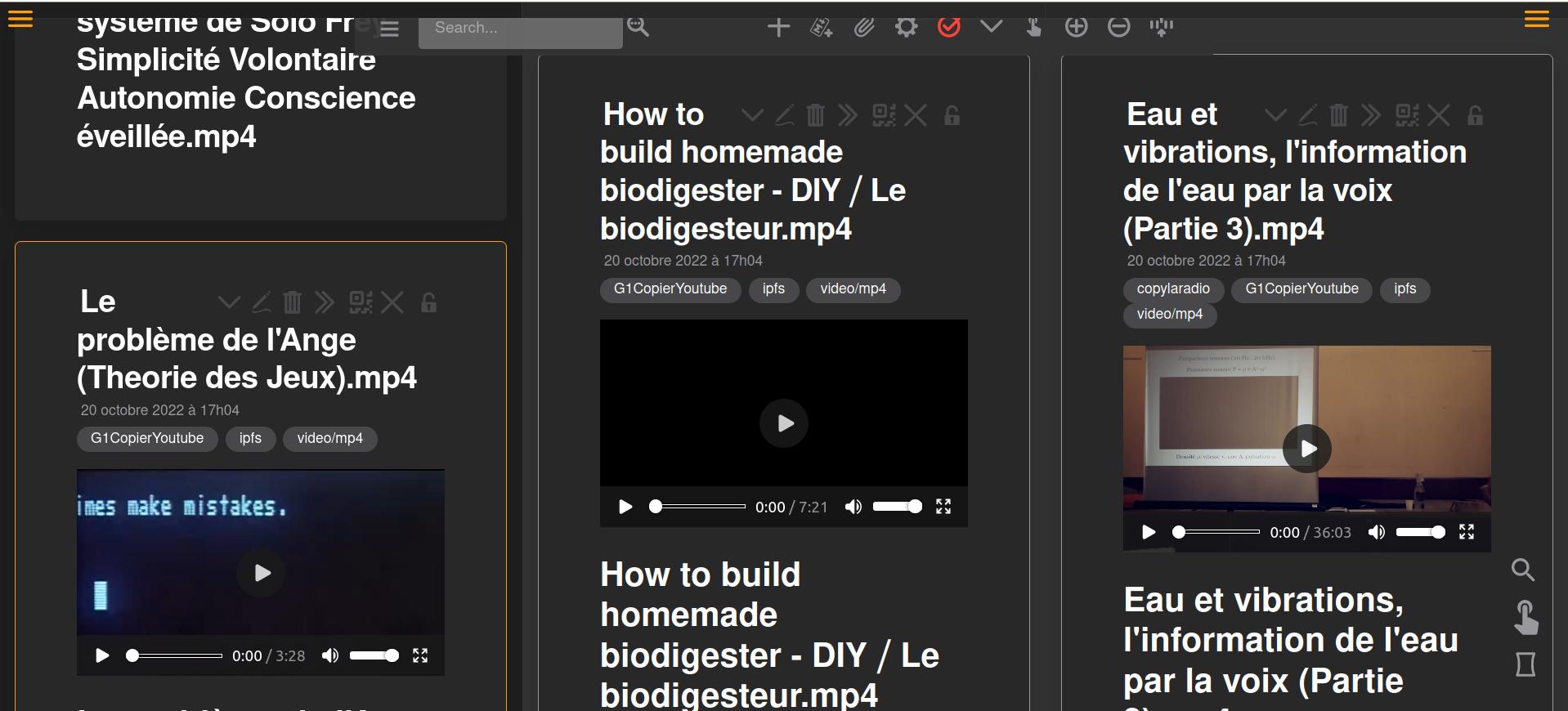
Thanks to “ipfs record plugin” and the help of multi-column them we made a Multimedia TW extendable as community hosted on IPFS
This experience makes me discover a few things:
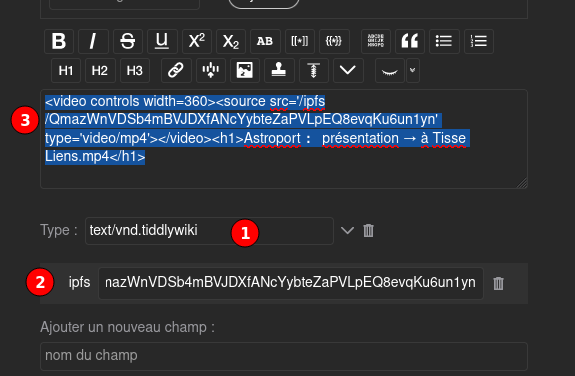
1/ I realize that as other “type”, “video/mp4” and _canonical_url doesn’t work. I need to create htlm5 video but “text/vnd.tiddlywiki” type to play it (see tiddlers bypass code)
2/ Tiddlers are created using node.js tiddlywiki (CLI TW), but are not appearing as “recent”, so I use #:[tag[G1CopierYoutube]] inline filter, but this is only applies to 1st column…
To be honest, I don’t follow a lot of what you are talking about but it does look exciting;
Given your mention of the “video wall” the Muuri plugin is also like the MCL Multi-column layout, but I have experimented with it, over multiple desktop screens. Perhaps with muuri a large multi-screen video wall would be really useful. Note Muuri can be less structured than MCL.
It made the same to me before using a cryptographic data management.
This “crypto land” is no more a directory and files structured place, it becomes lost hash in a bitswap, where keys memorize chains (hash+timestamp+signature).
IPFS brings it to network level level and creates a “fluid virtual drive” from all or bunch of running nodes. Actually CDN are using it, but it is a technology for people using ipfs to run away from data-centers, lots are still missing the point.
Compared to “Hard Disk Drive” semantics.
Astroport.ONE creates a kind of “BIOS” for IPFS drive used with a key pair
Port 1234 is redirecting to “Master Boot Record” (ip:port) redirecting to the “Allocation Table” showing files to the “Operating System”. We use TW as allocation table and admin, debug interface to help developing Distributed App above it.
TW automatically benefits of a “collective distributed hosting service”.
From the “alpha stage” login (BIOS) page http://qwantic.com:1234
clic on the link in the “yellow pop” to reach the form creating a new one.
Click on the “next yellow” pop (and refresh as it could take 30s to get ready)
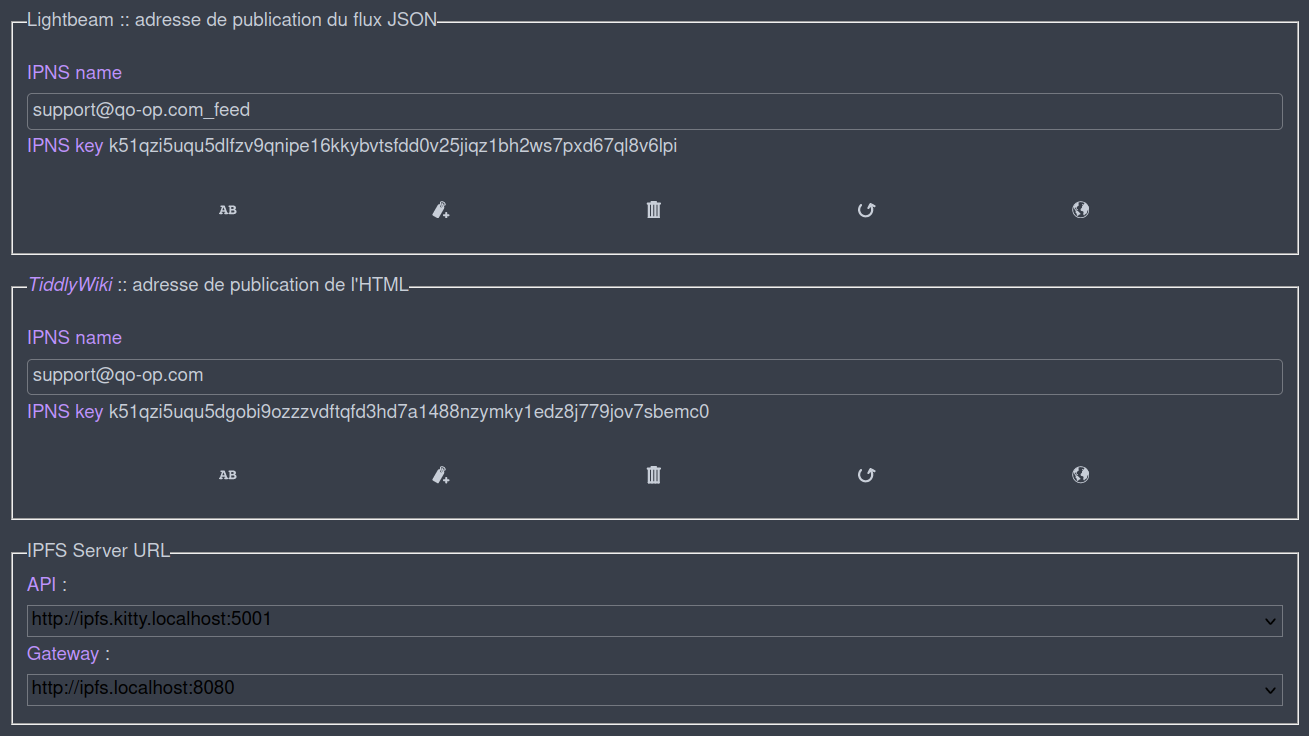
From 2 pass phrase and an email, it generates keypair and permanent ipns address of the TW (only those who have the key installed in their ipfs keystore can modify it)
Given my limited understanding, IPFS (InterPlanetary File System) is similar to Bittorrent in that it is a distributed storage protocol that is designed to interact with blockchains and act as a protocol that can be accessed for serving static files like web pages (html files), images, or video files. Brave browser, for example, allows one to directly access ipfs files. Like Bittorrent the files are broken up and distributed across hosts making them theoretically persistent in the face of shutdowns and censorship since there is no central server. The persistence depends on hosting though, so it’s not as bullet proof as many assume.
So you could store wikis or webpages in this distributed cloud. The wikis can be problematic I think because the files are stored statically, hence AFAIK each update to the wiki would require a new file to be generated. Not as big a deal for TWs served via node maybe but definitely for a frequently updated html TW. Currently it’s mainly used for the images associated with NFTs.
This does look very interesting. I have a node that I store my own NFTs on but I don’t keep it up all the time since it’s just my personal files.
I don’t think a lot of people realize that the images associated with their NFTs are not persistent if they are only stored on one server like the commercial services most images are stored on.
I bet a service that used tiddlywiki to store and organize information about NFTs along with bringing those hashed files to a distributed set of nodes or even a personal node would be extremely useful and appealing. Esp as the use cases for NFTs expand out past the profile pictures that most people associate with them and into things like identity and contracts.
That’s the purpose of Astroport.ONE. Programmed to run a bit swap party at 20H12 everyday to synchronize Ŋ1 network of TWs (based on confidence star exchange between keys and profile within htpps://gchange.fr)
This makes your TW backup by your friends
And you backup them.
Each new Astroport.ONE Station open TCP/GET ports
port 1234 to receive reading/writing API call (RAM)
port 12345 is for reading “bootstrap stations official memory” (EEPROM)
API still evolving
Relying on a p2p protocol, makes you need to have a full day running computer to maintain data “alive”. Or ask friends to do so. This involve a private key run delegation on their machine (you have to trust not bad using it).
Some are paying for “pinning” services… And big “key delegation providers” are coming.
We don"t want to share our private keys to any “commercial corporation”
So we decided to organize this service differently. For this, we are not using gambling crypt0 or dept money to build value our exchanges. We use G1 “monnnaie libre” a real outsider. The mathematically proven “best formula” of creating “coins” for a “group of people” living 80 years in average.
I know NFT are the promise to “reward” artists, but being able to maintain that control over digital media needs a 100% crypto land adoption. I suspect the recent "QRCode for a Restaurant’ period we lived in France was an “adapt to what is coming” digital_ID evolution. Not sure.
Astroport.ONE is alpha stage.
We are looking for beta tester and TW wizards (as it is the first operating system booting)
In order to Upload to IPFS, create Tiddler, import into TW, publish to IPNS, it is done through bash scripts. As you delegate the use of a “private key” to accomplish this process, and establish “web of trust”. This makes your TW updated by programs using data from the TW’s of your friends. Each IPFS node being part of this mesh storage & sharing network.
I am not sure I respond to your questions.
The code doing it is available on github, it is tested and developed through BOX OpenCollective cofunding starting a decentralized IPFS co-hosting “swarm of friends”
Because I did not know what IPFS is I did some research and stumbled upon this video
It is a good start to get a glimpse of understanding what IPFS tries to achieve.
Question: Is my understanding correct that this experiment tries to use TW as a frontend to view IPFS data - capable of smuggling information through censorship borders?
@papiche,
Can you give us (or point us to) a simple tutorial how you get the ipfs videolinks to work so beautifully.
It seems to need more than just the ipfs-plugin (641.6 KB) and the videowall is not so easy to reverse-engineer.
Sorry, i went abroad, and spend time coding for a while
Yes. Exactly.
Everyone publish from localhost and data are replicated through us
This depends on gateways… For now, public ones… The best architecture would be if anyone host an ipfs gateway. In “LAN condition”, it is really fast. In WAN conditions, stations have to share the same “boostrap list” (that can be dynamic too)… Speed should come with users
Astroport.ONE consists on ipfs and localhost API, served through netcat, launching CLI command line tools to manipulate tiddlywiki and ipfs keys in sync… It works pretty well (this one hosts more than 100GB)
It has not been so well documented.
@JanJo or anyone curious, we can arrange a call to show how it works and how to install it on your station.
Salut @papiche ,
avec plaisir - for me it would fit best after the easter-days.
I will have more ressources for brainconsming work then.
In what medium would you do the call?

 BOX
BOX
 Merci, chouette.
 cocoding