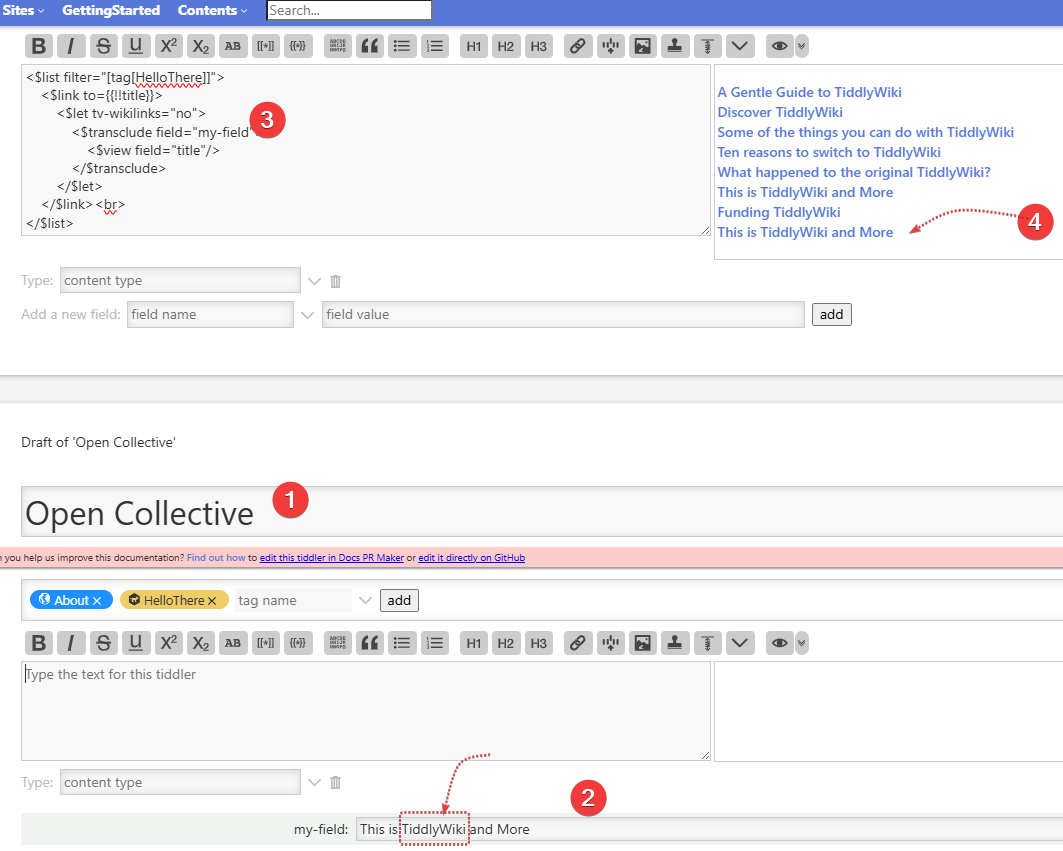
In below snippet, do we need $let tv-wikilinks="no"?
<$list filter="[tag[HelloThere]]">
	<$link to={{!!title}}>
		<$let tv-wikilinks="no">
			<$transclude field="my-field">
				<$view field="title"/>
			</$transclude>
		</$let>
	</$link>
</$list>

In below snippet, do we need $let tv-wikilinks="no"?
<$list filter="[tag[HelloThere]]">
<$link to={{!!title}}>
<$let tv-wikilinks="no">
<$transclude field="my-field">
<$view field="title"/>
</$transclude>
</$let>
</$link>
</$list>
If my-field contains CamelCase text, the $tranclude widget will render that CamelCase text as a link, which would open a tiddler other than the one indicated by the $link widget’s to={{!!title}} param.
-e
I tried to test this on TiddlyWiki v5.3.8 — a non-linear personal web notebook.
So I opened Open Collective tiddler, added my-field with below content:
This is TiddlyWiki and More
and make sure the Enable automatic CamelCase linking was enebaled. The result is given in the below picture. It seems I have one link not two! The TiddlyWiki word is not a separate link. What do you think?
Your original question was whether <$let tv-wikilinks="no"> is needed.
In your subsequent test, you still have <$let tv-wikilinks="no">, which specifically prevents the automatic CamelCase linking. If you remove or disable that (e.g., <$let XXXtv-wikilinks="no">), then the TiddlyWiki word IS a separate link from the surrounding text.
-e