It sounds like you’re describing something like the <<toc-selective-expandable>> macro (take a look at the “Selective” tab here for a demo and comparison with the other TOC macros). You could put this in a $reveal popup (“dropdown”) in the same way you put anything else in a $reveal popup, though you’d need to include class="tc-popup-keep" to prevent the popup from closing when you click inside it.
However, the core TOC macros do depend on tag relationships, so you’ll need a variation if your data structure isn’t based on tags. I’d take a look at @pmario’s TocP plugin and/or @EricShulman’s TiddlyTools TOC, to begin with; both adapt the TOC macros to work with another field of your choice. If neither meets your needs out of the box, they may give you a good place to start.
Could you say more about your current/ideal data structure? What’s the relationship between Item 1, Item 1a1, and Item A? This will probably inform the kind of solution you need.
Depending on the complexity of your data structure (and on how you intend to use items in the tree structure—are they links? buttons? is it a navigational aid like the Contents tab on tiddlywiki.com?) you may also wish to consider an alternative presentation—for instance, a set of $select widgets, where each selection determines the options available at the next level. I say this in part because rendering a list of thousands of items may introduce some noticeable lag in your browser, even if you don’t have all the nodes open at once—and more complex items (e.g. a button vs. a simple link) will compound the issue.
If you do start to experience lag when displaying long/complex lists, you may want to consider adding an eventcatcher. Here’s a good introduction by @Scott_Sauyet and another demo by @CodaCoder.
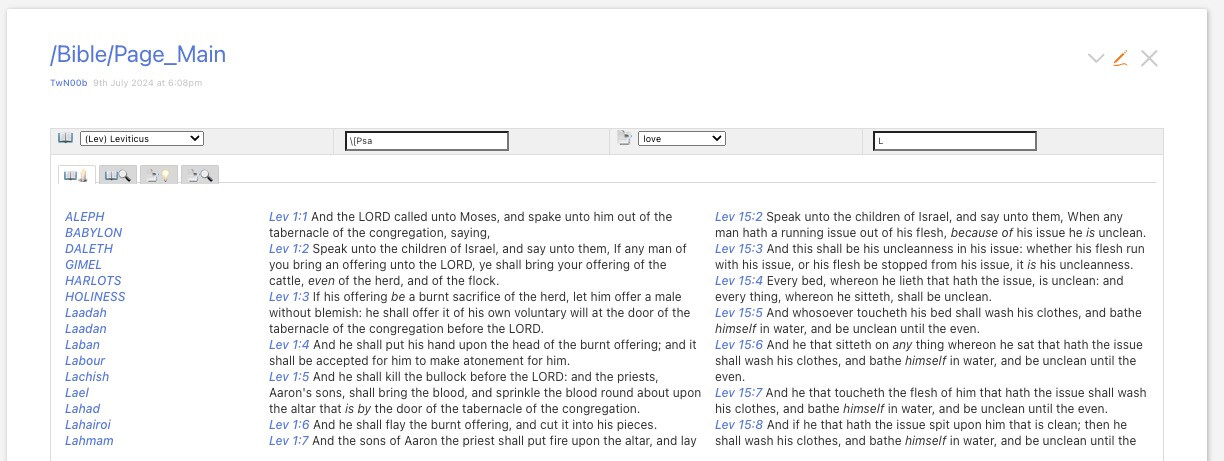
Using a “list filter” on a dictionary - to generate content - each time the drop-down is selected - is more expensive than just using a Static DropDown - unsure though
Keep it simple and make it a multi-step approach
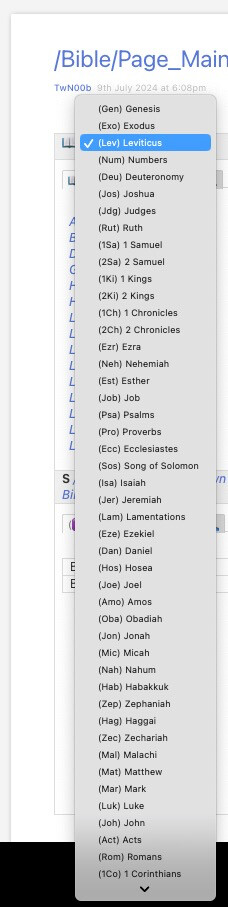
a. Popup 1 → Set’s “Field/Popup1” ( that will be used in Popup 2 )
b. Popup 2 → Set’s “Field/Popup2” ( that will be used in Popup 3 )
c. Popup 3 → Set’s “Field/Popup3” ( that will be used in Popup 4 )
d. Popup 4 → Set’s “Field/Popup4” ( that will be used in Popup 5 )
e. Popup 5 → Set’s “Field/DisplayMe” ( that in turn shows what I need from the Dictionary )
See if I can decipher and use something you posted ← This is my hope
As for data - I’ve a small sample dictionary shared here - that can be used:
This said - this is actually a small Dictionary - the one I want to actually work with (a personal one) is close to 2 million lines - aka indexes. I actually think TiddlyWIki will be OK with this - (just a gut feeling from a consumer - not dev person).
I hope this helps - and Thanks - I will look at this in a couple of hours.
Just to help put this in context, when using single file wikis, the whole wiki is loaded into memory, and many features such as tags and tiddler titles have caches to improve look up performance. This really means performance is usually very good.
The question then become which interface to use when dealing with long lists.
I think this is a reasonable approach and you can store the selected results and use the values as context, so you can go to the next in each level.
If you can create a tiddler which when displayed allows you list and browse through a large, perhaps selectable table of contents you can make a button that opens this tiddler in a modal to make a selection.
When selecting from large lists apparently the LinkCatcherWidget is an efficient way
On desktops you can even open the aforementioned TOC tiddler in a new window and in effect “Remote Control” your wiki, great for multiple screens.