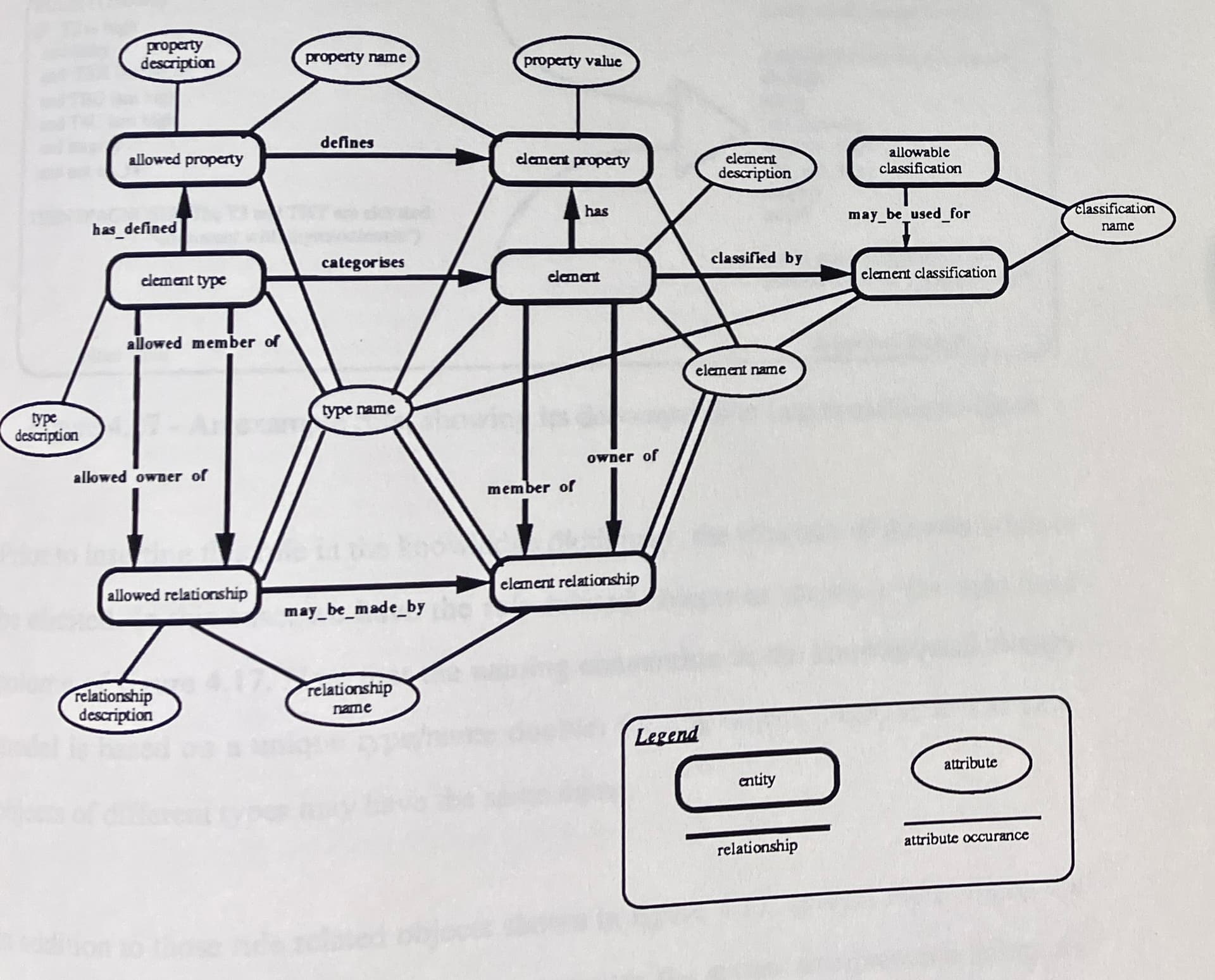
Yes a later version of the content model but not the storage model
Bobj

Yes a later version of the content model but not the storage model
Bobj
The content model can be changed at any time with no change to the storage model or coding. The entities on the diagram are stored as entity_types and the relationships as allowed_relationships
@pmario I have scanned the paper I mentioned above and it is available from here https://turtlelane.com.au/Papers/KBS89.pdf
bobj
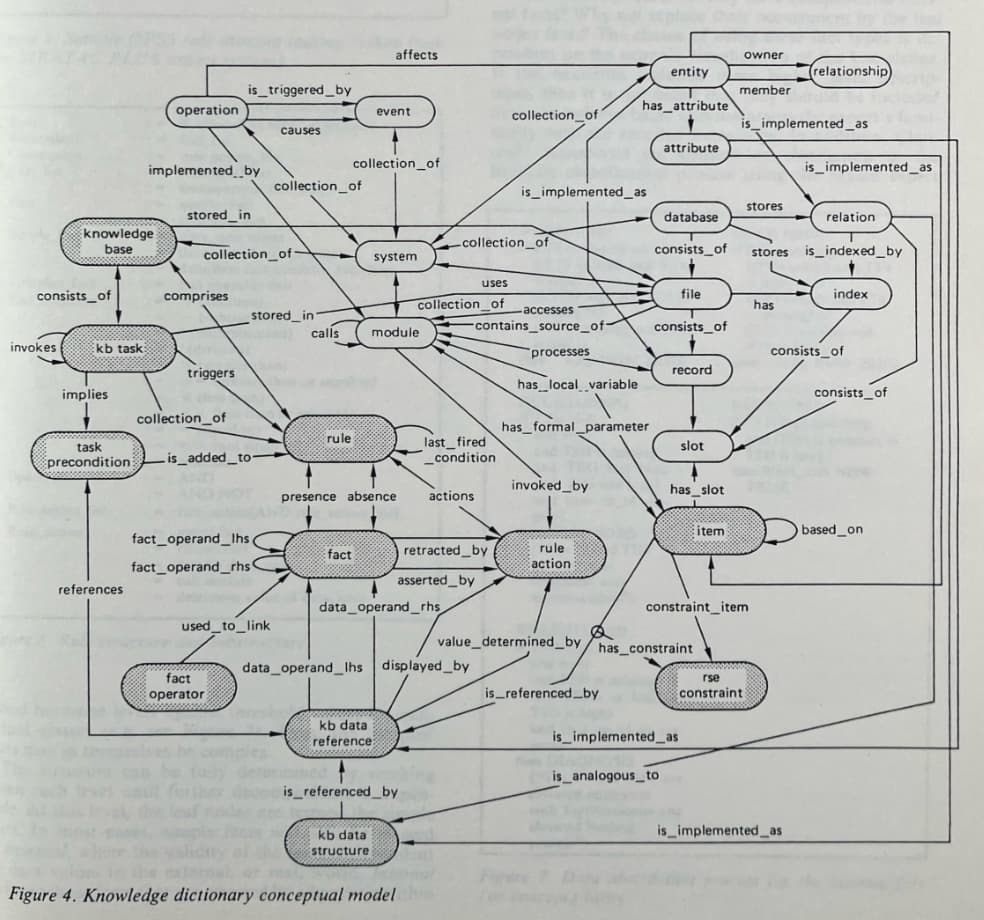
For those interested, here are some diagrams detailing the Knowledge Dictionary storage and conceptual models.
This is the storage model diagram
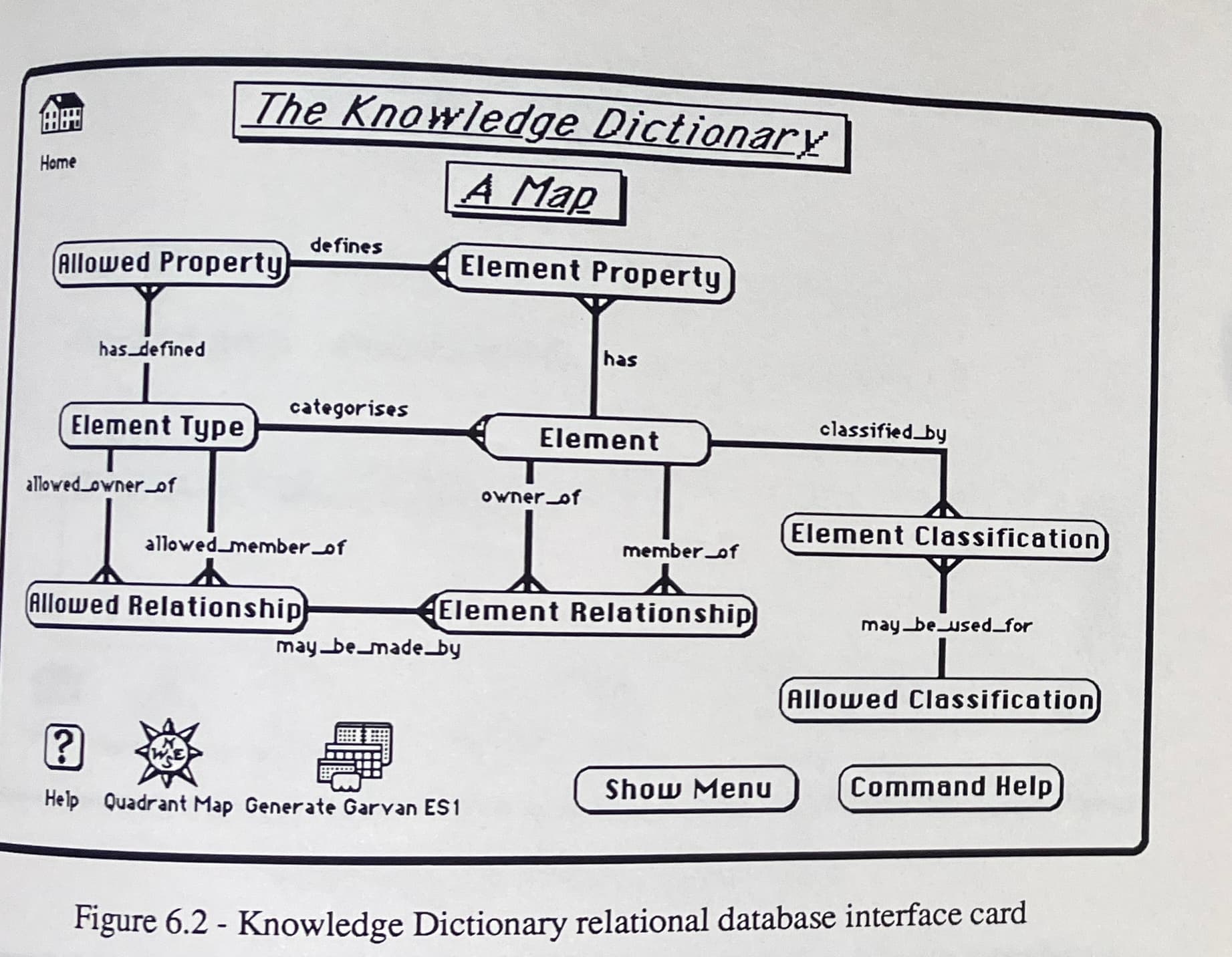
and this is its implementation in Hypercard. For those who remember Hypercard, each entity in the model was implemented as a Hypercard stack, the equivalent of a relational database table. The relationships were recorded using foreign keys between the table records.
The ‘allowed’ entities were used to ensure only valid data elements were stored in the related three tables. So the dictionary’s conceptual model was recorded using the ‘allowed’ tables.
I quite like this idea and demo and can see how it can easily be applied to a real world database. However, I do see one potential issue that were you to deploy this publicly your whole database is ‘exposed’. This of course does not happen with more conventional database tool that you are running SQL queries against.
Is there a way around this, or have I misunderstood?
I would only expect to use this in cases where the wiki itself is the database. If the dataset is too large to be contained in a single wiki, then I don’t think TW is the proper tool for displaying it either.
So this is useful for dozens, hundreds, thousands or perhaps even tens of thousands of primary entities. But I wouldn’t expect it to scale to hundreds of thousands or more.
For yesterday’s municipal election, I had slowly created a wiki that listed all the voters in my small town, all the officeholders, all the candidates, all the members of my local political party, and had tiddlers for every membership and every candidacy. We tracked things like lawn-sign placement, postcards sent, doors knocked, etc. But the total number of tiddlers is fewer than 5000, which TW handles without a glitch. I couldn’t do the same thing in a large population town. Bur for this case it works well.
@Bob_Jansen I am interested in your model because I have an interest in knowledge representation and especially, I would like a great tool for (a kind of) argument mapping.
@alanc , you might want to have a look at Toulmin Argument Structures. Toulmin was an English philosopher/semiotitian who wrote a great book proposing a general argument structure. There is a lot of info on Toulmin online but his book, although old, is worth getting.
You can use the model I worked on in knowledge representation to store and process Toulmin formalisms.
Good luck.
Bobj
Do you want to map actual arguments, or just a schematic for argumentation?
This Toulmin structure is just a general "cover these bases while advancing an argument (or preparing a debate, etc.). Its ok, but can’t illuminate how the inferences work in a particular argument.
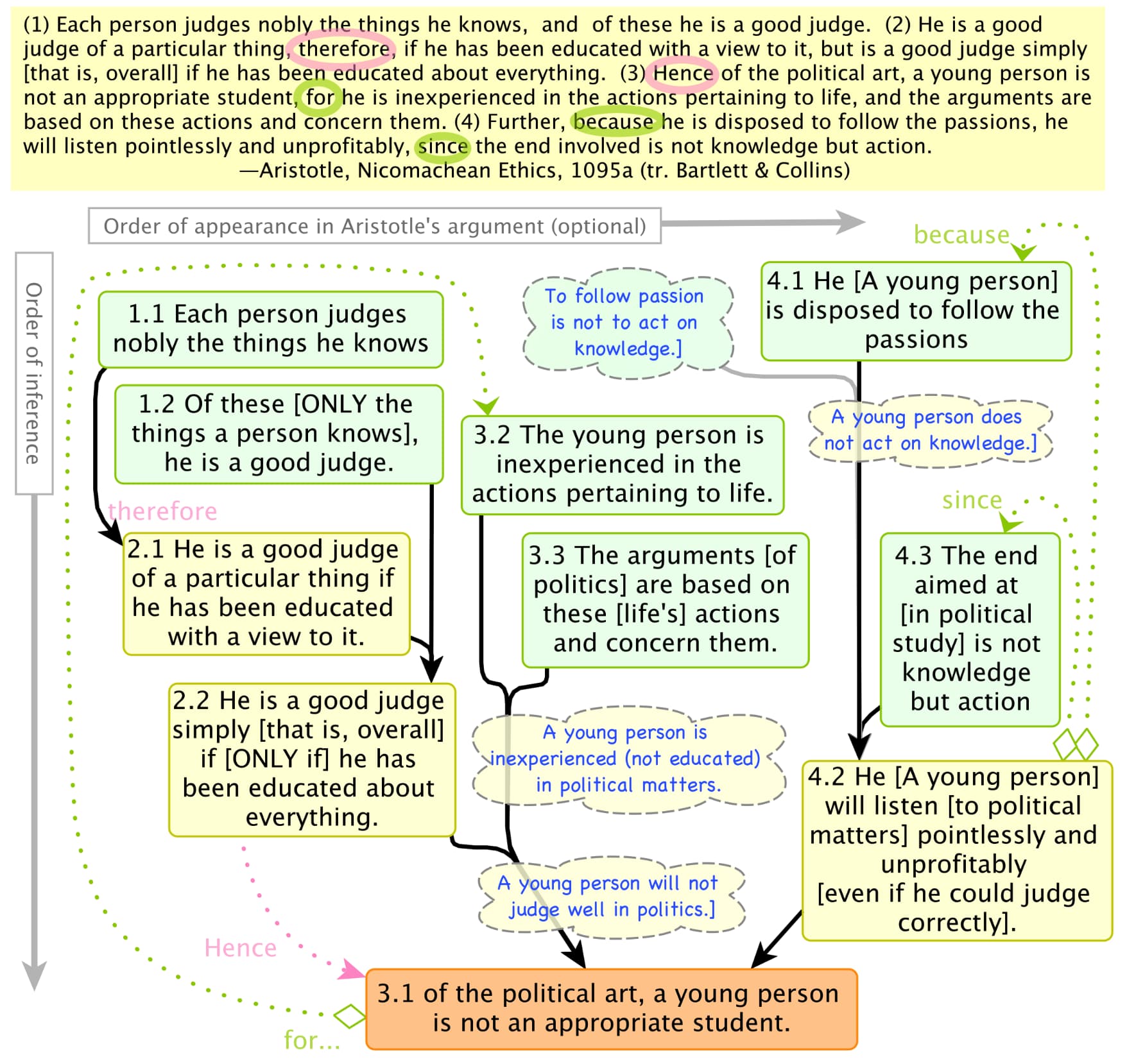
If you want to diagram specific arguments, you might want something more like a modified Beardsley diagram. A Beardsley diagram conventionally uses numbers to represent claims, but with good diagramming tools you can put the actual claims into a visually clear layout.
Here’s an explanation/overview… and here’s an example pasted in (This one is an argument I always make my students analyze in order to find multiple possible angles of critique.)
Thank your for your intervention. I don’t think I will have enough time/needs to go into that much detail though, but it is still great to study. By the way, what do you use to create these diagrams?
Whoa! That is one cool TiddlyWiki!
I think that’s among the many diagrams I’ve made with OmniGraffle (paid software with a mac-first development model, I think). It’s great about letting shapes have directional arrows connecting them, with “magnets” at each end that allow repositioning of the shape-elements (so that arrow connections follow intuitively). Once a “template” is set up (in this case, the set of models for premise/implicit-premise/subconclusion/conclusion “nodes” in terms of shape, opacity, color, shape, text-styles, etc., plus models for the various connective arrow styles), it’s easy to re-use those elements, or make a change that cascades through nodes of the type in question.
If I had a parallel career-worth of energy, I could imagine making a targeted (inference-diagram-specific) app that focuses on ushering students (and others) through building such diagrams.
You and me, both. So many spheres of study, so very little time. 
I concur entirely @Springer , OnmiGraffle is a wonderful drafting tool that I have used for years. It is often described as Visio for the Mac.
bobj